
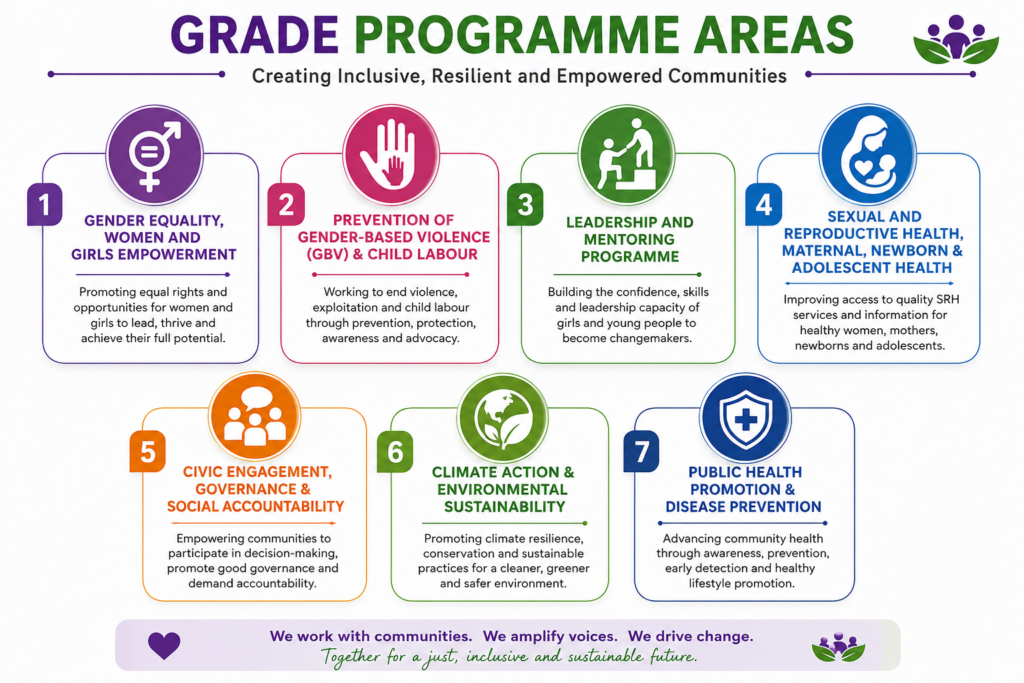
1. Gender Equality, Women and Girls Empowerment
This programme area works to advance the rights, agency, and status of women and girls across social, economic, and political spheres. It addresses structural barriers to equality — including discriminatory norms, unequal access to opportunities, and limited decision-making power — through advocacy, skills-building, economic empowerment initiatives, and community sensitization. The goal is to enable women and girls to exercise full autonomy over their lives, participate equally in society, and access the same opportunities as their male counterparts.
2. Prevention of Gender-Based Violence (GBV) & Child Labour
This programme addresses two interlinked forms of exploitation that disproportionately affect women, girls, and children. It combines prevention through community awareness and behaviour-change campaigns with survivor-centred response services — including safe reporting mechanisms, referral pathways, and access to legal, medical, and psychosocial support. On child labour, the focus is on withdrawal, rehabilitation, and reintegration of affected children into education and safe family environments, alongside efforts to address root causes such as poverty and weak enforcement of protective laws.
3. Leadership and Mentoring Programme
This area is dedicated to building a pipeline of confident, capable girls and youth leaders equipped to influence change in their communities. Through structured mentorship, leadership training, and exposure opportunities, participants gain the skills, networks, and confidence needed to take on leadership roles in their schools, workplaces, and communities. The programme emphasizes intergenerational learning, pairing experienced mentors with emerging leaders to sustain a cycle of empowerment.
4. Sexual and Reproductive Health, Maternal, Newborn & Adolescent Health
This programme promotes access to accurate information and quality services related to sexual and reproductive health across the life course — from adolescence through motherhood. Activities include comprehensive sexuality education, family planning access, antenatal and postnatal care support, and adolescent-friendly health services. The aim is to reduce maternal and newborn mortality, delay early pregnancy, and ensure women and adolescents can make informed, autonomous choices about their bodies and health.
5. Civic Engagement, Governance & Social Accountability
This area strengthens the participation of citizens — particularly women and youth — in governance and public decision-making processes. It builds capacity for civic education, community advocacy, and engagement with local government structures, while promoting transparency and accountability in the delivery of public services. The objective is to ensure that marginalized voices are represented in governance and that duty-bearers are held accountable to the communities they serve.
6. Climate Action & Environmental Sustainability
This programme addresses the intersection of environmental sustainability and social equity, recognizing that women, girls, and children are often most vulnerable to climate impacts. Initiatives include environmental education, community-led conservation efforts, climate resilience building, and promotion of sustainable practices such as afforestation and waste management. The focus is on equipping communities — especially women — with the knowledge and tools to adapt to and mitigate climate change.
7. Public Health Promotion & Disease Prevention
This programme focuses on improving community health outcomes through preventive health education, disease awareness campaigns, and promotion of healthy practices such as sanitation, hygiene, and nutrition. It also supports access to preventive health services, including immunization and screening programmes, with particular attention to vulnerable groups. The goal is to reduce the burden of preventable diseases and build stronger, health-literate communities
Our Approach
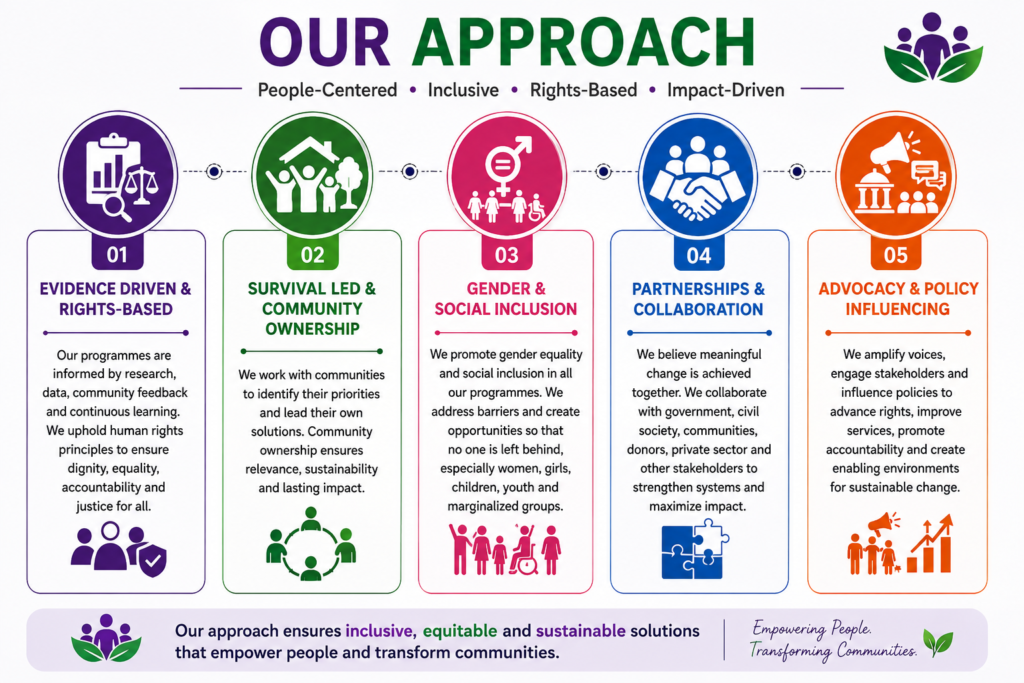
At Grassroot People and Gender Development Center (GRADE), our approach is people-centred, evidence-driven, and community-led. We work alongside communities to develop sustainable solutions that promote dignity, equality, and lasting social change.
1. Evidence-Driven & Rights-Based
Our programmes are grounded in human rights principles and informed by research, data, community feedback, and continuous learning. We use evidence to design, implement, monitor, and improve interventions that uphold dignity, equality, accountability, and social justice.
2. Survivor-Led & Community Ownership
We believe sustainable change begins with the people most affected. We empower survivors and community members to identify priorities, shape solutions, and lead actions that address local challenges, ensuring ownership, relevance, and long-term impact.
3. Gender & Social Inclusion
We mainstream gender equality and social inclusion across all our programmes, ensuring women, girls, children, youth, persons with disabilities, and other marginalized groups have equal opportunities to participate, lead, and benefit from development initiatives.
4. Partnerships & Collaboration
We recognize that lasting development requires collective action. We work with governments, civil society organizations, community-based organizations, development partners, the private sector, academic institutions, and local communities to strengthen systems, leverage resources, and maximize impact.
5. Advocacy & Policy Influencing
We amplify community voices and promote evidence-based advocacy to influence policies, strengthen accountability, and create enabling environments that protect rights, promote inclusion, and improve the well-being of vulnerable populations.
